
Echoes of Resilience: Women's Voices and Agency in Nso Cultural Traditions of the Bamenda Grassfields of Cameroon
Published 2026-11-28
Keywords
- Women's voices,
- Women's agency,
- Nso cultural traditions,
- Bamenda Grassfields,
- Nso matriculture
Copyright (c) 2026 Happiness Yinyuy (Author)

This work is licensed under a Creative Commons Attribution-NonCommercial-NoDerivatives 4.0 International License.
How to Cite
Abstract
This paper explores the echoes of resilience embodied in Nso women’s voices and agency within the Bamenda Grassfields of Cameroon. The Nso People trace their history to Princess Ngonnso, the founding mother of the Nso ethnic group. Ngonnso represents the foundational female figure whose legacy underscores women’s enduring spiritual and symbolic significance in Nso society. Although Nso has a centralised patriarchal social structure headed by the Fon and assisted by a council of traditional rulers and regulatory societies, women have demonstrably matricultural functions when transmitting oral traditions, teaching cultural values, organising communal labour, and preserving Indigenous knowledges. Nso women’s roles in reproduction and community development further position them as major sources of continuity and power. This study draws on historical analysis, oral traditions, and contemporary accounts to reveal women’s power in Nso socio-political landscape. Findings reveal that although women are largely excluded from formal male-controlled political councils and public decision-making - justified by male hegemonic ideologies - forms of influence persist through informal networks, religion, and resistance to exploitative customs. This article argues that women’s agency in Nso culture is not merely reactive but a persistent, resilient force that sustains social cohesion, economic vitality, and cultural identity amid patriarchal constraints.
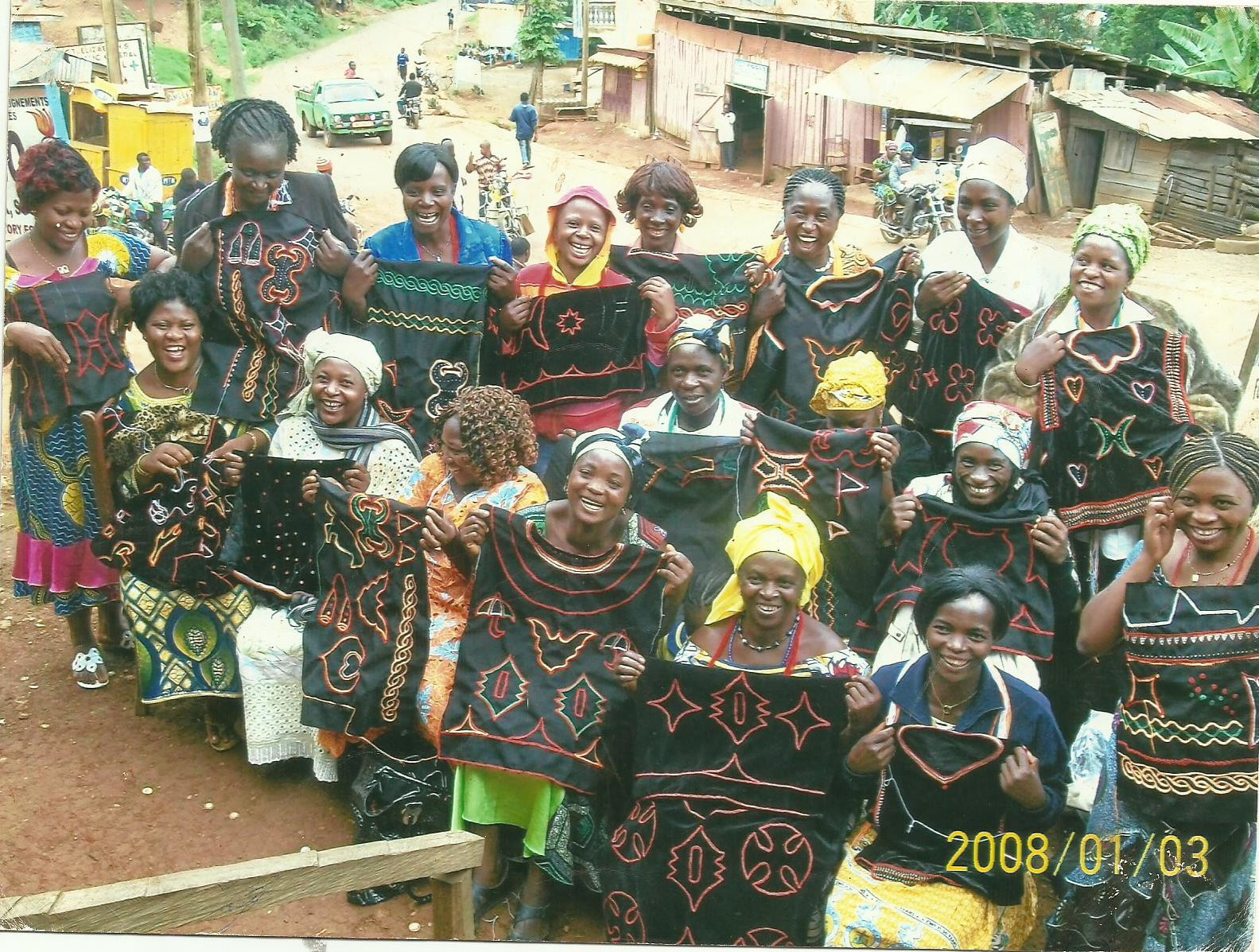
Image caption: Nso women after an embroidery training workshop organized by the Christian Women Fellowship (CWF) of Bui Presbytery of the Presbyterian Church in Cameroon to empower women financially. This training was held at the Presbyterian Youth Centre Kumbo-Nso in 2008. © Happiness Yinyuy, 2008.
References
- Adams, Melinda. “Colonial Policies and Women’s Participation in Public Life: The Case of British Southern Cameroons.” African Studies Quarterly 8, no. 3. Spring 2006.
- Banla, N. K., Paul Animbom N., and Nixon Takor K. “Pictures (Images) and Construction of Gender Roles among the Nso’ of Cameroon.” International Journal of Research and Innovation in Social Science 4, no. 1. 2022.
- BBC News. “Ngonnso Statue in Germany Restitution Initiative.” BBC News, June 2023.
- Chilver, E. M., and P. M. Kaberry. Traditional Bamenda: The Pre-Colonial History and Ethnography of Bamenda Grassfields. Vol. 1. Buea: Government Printer, 1967.
- Fanso, V. G. Cameroon History for Secondary Schools and Colleges, Vol. 1: From Prehistoric Times to the Nineteenth Century. London: Macmillan Publisher, 1989.
- Feldman-Savelsberg, P. Plundered Kitchens, Empty Wombs: Threatened Reproduction and Identity in the Cameroon Grassfields. Ann Arbor: University of Michigan Press, 1999. https://library.oapen.org.
- Goheen, M. Men Own the Fields, Women Own the Crops: Gender and Power in the Cameroon Grassfields. Madison: University of Wisconsin Press, 1996.
- Geertz, C. The Interpretation of Cultures: Selected Essays. New York: Basic Books, 1973.
- Guedon, Marie-Francoise. “Introduction to Matriculture.’’ Matrix: A Journal for Matricultural Studies 1, no. 1 (May 2020) 6 https://www.networkonculture.ca/activities/matrix.
- International Crisis Group. “Women and the Anglophone Crisis in Cameroon.” Africa Report No. 285, 2022.
- Kaberry, P. M. Traditional Politics in Nsaw. Oxford: Oxford University Press, 1959.
- ____________. Women of the Grassfields: A Study of the Economic Position of Women in Bamenda, British Cameroons. London: Her Majesty’s Stationery Office, 1952.
- Kumela, H., Wiiybaa wo Mbonkisan, and daughter of Shufai Ntselah, Kiyan-Kumbo. Interview by author, December 25, 2025.
- Lantum, D. N. The Nso’ Went to Mvem 16-18 December 1994. Kumbo: Nso History Society Publication, 2002.
- Leinyuy, C. G. “Nso Traditional Political Institutions.” Postgraduate Diploma in History thesis, University of Yaounde, 1983.
- Mbinglo, J. Ayufowontoh. Princess of Nso, Fondom, cultural activist, teacher, and trader in Buea. Interviewed by author, December 31, 2025.
- Ngoran, D. B. “Incidental Benefits of Female Constituted Social Groups in Nso’ Polity of the Cameroon Grasslands: Colonial and Post-Colonial Appraisal.” International Journal of History and Cultural Studies 7, no. 1 (2021).
- Njilla, M. R. “Management of Property/Resources for Sustainable Rural Livelihoods in Bui Division, Northwest Region of Cameroon.” MSc dissertation in Geography, University of Buea, 2009.
- Njobati S. Nso female activist in Germany involved in the restitution of Ngonnso / Bring Our Mother Back Home initiative.
- Nkeneh, Y. C. “The Role of Women in the Political Transition of the Bamenda Grassfields Fonship Institutions in Cameroon.” International Journal of Humanities, Social Sciences and Education 10, no. 9 (September 2023). https://www.arcjournals.org.
- Nkwi, P.N. and Jean -Pierre Warnier. Elements for History of Western Grassfields. University of Yaounde: Department of Sociology, 1982.
- Nsamenang, A. Bame, and Michael E. Lamb. “The Acquisition of Socio-Cognitive Competence by Nso Children in the Bamenda Grassfields of the Northwest Region of Cameroon.” International Journal of Behavioral Development 16, no. 3 (1993): 429. https://journals.sagepub.com.
- Nyuykighan, M. D. “Gender Representations in Selected Nso Folktales of the Northwest Region of Cameroon.” International Journal of African Society, Cultures and Traditions 13, no. 1. 2025
- Open Restitution Africa. “Ngonnso Statue Restitution Documentation.” Open Restitution Africa Project, 2025.
- Rowlatt, Linnea. “Blind: The Western gaze at matricultures, historically. Part I,” Matrix: A Journal for Matricultural Studies, 1:1 (2020), 17; based on Geertz’ famous definition in ‘Religion as a Cultural System’ in The Interpretation of Cultures. New York: Basic Books, 1973.
- Verye Emilia. Farmer from Kifem/Mbam. Interviewed by author, December 26, 2025.
- Verye, Fai Michael. “The Truth and Reconciliation Commission (TRC) and Nso Kidiif Ritual as Model of Genuine Reconciliation.” Doctorate thesis, Protestant University of Central Africa, 2007.
- Wiysahnyuy Angelica. Farmer and “buy am sell am” food crop business woman. Interviewed by author, June 6, 2018.
- Yinyuy, H. “Nso Response to Colonial Administration and Christianity, 1902-1961.” Long essay, Department of History, University of Buea, 2005.
- __________. “Indigenous Leadership and Governance in Colonial and Post-Colonial Cameroon: A Historical Analysis of Traditional Institutions among the Nso People.” Journal of Developmental Issues in Education and Humanities 1, no. 3 July 2025.
- __________. “The Evangelising Efforts of the Presbyterian and Catholic Women Associations in Nso, Cameroon 1961-2013.” PhD thesis, University of Yaounde 1, 2020.