
Published 2026-11-28
Keywords
- video art,
- Taghizadeh,
- Razmi,
- Iranian matriculture,
- transnational media
Copyright (c) 2026 Sandra Skurvida (Author)

This work is licensed under a Creative Commons Attribution-NonCommercial-NoDerivatives 4.0 International License.
How to Cite
Abstract
This article investigates the matriculturality of resistive video art of Iran via a comparative case study of the works of two artists, Jinoos Taghizadeh, a prominent Iranian artist, writer, and activist who lives in exile in Canada since the repressions against the Woman Life Freedom movement, and Anahita Razmi, a German-Iranian diaspora artist based in London. The comparative analysis of their works, Taghizadeh's Good Night (2009) and Razmi's The Indivisible Sky (2025), elucidates the specific sociopolitical conditions to which they are addressed. Good Night features a lullaby of revolutionary anthems sung by a female voice translating the sound of awakening during political upheavals—the revolution of 1979 and the Green Movement of 2009—into the regenerative silence of sleep; The Indivisible Sky translates and redistributes among speakers of diverse identities fragments of self-reflexive writings by women about their societal roles ranging from the early twentieth century to the present and triggered by Woman Life Freedom movement in Iran. Both artists are dedicated to the creation of a contemporary Iranian matriculture, inserting its signifiers into circulation within a transnational media environment.
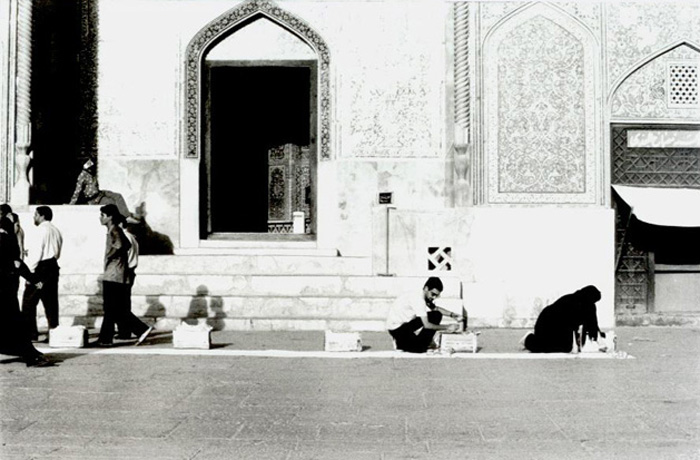
Image caption: a still from the film A Performance for a Nazr, A Nazr for a Performance, 2003. © Jinoos Taghizadeh
References
- Acuff, Jonathan, and Yahya Kamalipour, eds., Media, Power, and Politics in the Digital Age: The 2009 Presidential Election Uprising in Iran (Lanham, Maryland: Rowman and Littlefield, 2010).
- Alarcón, Miguel Molina, Sound Experiments in the Russian Avant Garde: Original Documents and Reconstructions of 72 Key Works of Music, Poetry, and Agitprop from the Russian Avant Gardes (1908–1942) (London: ReR Megacorp, 2008).
- Alimagham, Pouya, Contesting the Iranian Revolution: The Green Uprising (Cambridge University Press, 2020).
- Allen, Kelly-Ann, Saeed Pahlevasharif, Shiqi Dong, and Steven Roberts, ‘Being a Woman in Iran: Lived Constraints, Desired Change, and Calls for Allyship,’ Women’s Studies International Forum 117 (2026); URL: https://doi.org/10.1016/j.wsif.2026.103326, accessed 14 November 2026.
- Antic, Marija, ‘Transnational Iranian Poetics of Resistance: the Green Movement and Iranian Women’s Agency in Sepideh Farsi’s “Red Rose” (2014),’ Feminist Media Studies, 23(7), 2023, 3498–3514; URL.: https://doi.org/10.1080/14680777.2022.2126870, accessed 14 November 2026.
- Auslander, Philip, ‘Digital Liveness: A Historico-Philosophical Perspective,’ PAJ: A Journal of Performance and Art 2012; 34 (3 (102)): 3–11; URL: https://doi.org/10.1162/PAJJ_a_00106 , accessed 14 November 2026.
- Braidoti, Rosi, ‘In Spite of the Times: the Postsecular Turn in Feminism,’ Theory, Culture, and Society, 25(6), 1-24; URL: https://doi.org/10.1177/0263276408095542, accessed 14 November 2026.
- Dadpour, Rana, and Hosna J. Shewly, ‘Dancing in-between: Interstitial Feminist Defiance in Iran’s Public and Digital Spaces.’ Third World Quarterly 46 (10): 1229-48.
- Deleuze, Gilles, ‘Mediators,’ Negotiations: 1972–1990, trans. Martin Joughin (New York: Columbia University Press, 1995), 121-134.
- Duranti, Andrea, ‘The Green Screen: Neda and the Lost Voices,’ International Journal of Communication 7 (2013), 1344–1370; URL: https://ijoc.org/index.php/ijoc/article/view/1554/930, accessed 14 November 2026.
- Foster, John Bellamy, ‘Marx’s Theory of Metabolic Rift: Classical Foundations for Environmental Sociology,’ American Journal of Sociology, 105 (2), September 1999, 366-405.
- Ghavami, Ghoncheh, and Bahar Noorizadeh, eds., e-flux Journal #145 (May 2024), URL: https://www.e-flux.com/journal/145, accessed 14 November 2026.
- Gheytanchi, Elham, ‘A Revolutionary Tradition: Shoars in Iranian Street Politics,’ Words Without Borders, September 18, 2009, URL: https://wordswithoutborders.org/read/article/2009-10/a-revolutionary-tradition-shoars-in-iranian-street-politics/, accessed October 25, 2026).
- Grigor, Tallinn, Contemporary Iranian Art: From the Street to the Studio (London: Reaktion Books, 2014).
- Hammelburg, Esther, ‘#stemfie: Reconceptualizing Liveness in the Era of Social Media,’ TMG Journal for Media History, vol. 18, no. 1, Sound & Vision, 2015, pp. 85-100. https://doi.org/10.18146/tmg.108, accessed 14 November 2026.
- Karimi, Pamela, Women, Art, Freedom: Artists and Street Politics in Iran (Leuven, Belgium: Leuven University Press, 2024).
- Kraidy, Marwan K., and Sara Mourad, ‘Hypermedia Space and Global Communications Studies: Lessons from the Middle East,’ Global Media Journal 9:16 (2009), 1-19, URL: https://www.globalmediajournal.com/open-access/hypermedia-space-and-global-communication-studies-lessons-from-the-middle-east.php?aid=35242, accessed October 25, 2026.
- Lotfalian, Mazyar, ‘Aestheticized Politics, Visual Culture, and Emergent Forms of Digital Practice,' International Journal of Communication 7 (2013), 1371-1390, URL: https://ijoc.org/index.php/ijoc/article/view/1556/931, accessed October 25, 2026.
- Mahdavi, Pardis, Passionate Uprising: Iran’s Sexual Revolution (Stanford, California: Stanford University Press, 2008).
- Manoukian, Setrag, “Where Is This Place? Crowds, Audio-vision, and Poetry in Postelection Iran,” Public Culture 1 May 2010; 22 (2): 237–263; URL: https://doi.org/10.1215/08992363-2009-027, accessed 14 November 2026.
- Muñoz, José Esteban, Disidentifications: Queers of Color and the Performance of Politics (Minneapolis, Minnesota: University of Minnesota Press, 1999).
- Mir-Hosseini, Ziba, ‘Broken Taboos in Post-Election Iran,’ Middle East Research and Information Project, December 17, 2009, URL: https://www.merip.org/2009/12/broken-taboos-in-post-election-iran/, accessed October 25, 2026.
- Moallem, Minoo, Between Warrior Brother and Veiled Sister: Islamic Fundamentalism and the Politics of Patriarchy in Iran (Berkeley: University of California Press, 2005).
- Niakooee, Seyed Amir, ‘Explaining the Crisis of the Green Movement in Iran (2009-2017),’ Democracy and Security, 21(3), 2025, 229-259.
- Mottahedeh, Negar, Whisper Tapes: Kate Millett in Iran (Stanford, California: Stanford Briefs, 2019).
- _____, #iranelection: Hashtag Solidarity and the Transformation of Online Life (Stanford, California: Stanford Briefs, 2015).
- Pourmokhtari, Navid, Iran’s Green Movement: Everyday Resistance, Political Contestation, and Social Mobilization (Routledge, 2021).
- Rancière, Jacques, Dissensus: On Politics and Aesthetics, trans. Steven Corcoran (New York: Continuum, 2010).
- Risse-Kappen, Thomas, ‘Ideas Do Not Flow Freely,’ International Organization 48, no. 2 (Spring 1994): 185–214.
- Saberi, Roxana, and Jamalpour, Fatemeh, ‘40 Iranian Doctors and Nurses Describe a Massacre,’ The New York Times, February 25, 2026; URL: https://www.nytimes.com/interactive/2026/02/25/opinion/iran-protests-doctors.html, accessed 14 November 2026 (paywall).
- Sameh, Catherine Z., ‘Woman, Life, Freedom: Iran’s Feminist Uprising in Historical and Transnational Perspective,’ Mary Caputi and Patricia Moynagh, eds., Research Handbook on Feminist Political Thought (Edward Elgar Publishing, 2024), 437-447.
- Skurvida, Sandra, ‘Iranian or Not: Sociopolitical Conditions of Art Representation,’ in Transkulturelle Wechselwirkungen durch Künste und Soziales: Iranische Diaspora in Europa und darüber hinaus (Transcultural Interplay Through Art and Social Life: Iranian Diaspora in Europe and Beyond), eds. Shirin Nowrousian, Michael Hofmann, and Tobias Schickhaus (Würzburg, Germany: Königshausen & Neumann, 2022), 183–89.
- —----’Who, by Whom, and for Whom: Presentation of Contemporary Art in Iran and Representations of the Art of Iran Elsewhere,’ Interventions Journal, January 29, 2013, URL; https://interventionsjournal.wordpress.com/2013/01/29/who-by-whom-and-for-whom-presentation-of-contemporary-art-in-iran-and-representations-of-the-art-of-iran-elsewhere/, accessed October 25, 2026.
- Taubman, Geoffry L. ‘State-sanctioned Surfing, Limited Connectivity, and Varied Access to Cyberspace in Nondemocracies,’ Asian Perspective 27, no. 2 (2003): 105–140.