
Published 2025-12-11
Keywords
- Yorùbá ,
- festival,
- Èró,
- matriculture,
- cross-dressing
Copyright (c) 2025 Ayodeji Abiona (Author)

This work is licensed under a Creative Commons Attribution-NonCommercial-NoDerivatives 4.0 International License.
How to Cite
Abstract
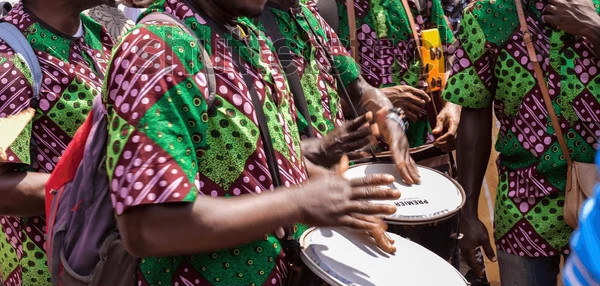
In literature, the Yorùbá feature prominently in discussions on rituals, festivals, and gender in socio-cultural practices. The Yorùbá, like many other African societies, is patriarchal. However, in practice and literature, reference to femininity and female agency is rife. Èró festival is a community-wide feast where men don feminine attires and process around the community. This article considers cross-dressing during traditional festivities as a symbol of feminine power, a gesture to female inclusivity, and a tool of social cohesion in a Yorùbá community. In order to interrogate the centrality of Èró festival – a matricultural complex – to the continued existence of the community, the paper relies on the abundant literature on Yorùbá religion, culture, and particularly, gender relations. It combines an analysis of these with oral interviews with recent participants in the festival and other traditional observances to analyze dress as a gendered item in festive cultural practices among the Yorùbá. The paper presents evidence of gender and dress both in literature and practice, limiting itself to Ùṣò in eastern Yorùbáland. It argues that female power, informed by their biologically-derived endowment, is ubiquitous and potent among the Yorùbá. In Ùṣò, men enact this feminine power through the symbology of dress.
References
- info. "Abissa 2024: les N'Zima de nouveau en fête." YouTube page Accessed on 26.05.2025. https://youtu.be/y9SbpfyrBbA?si=smk6-2oxMwCFbhpJ.
- Addo, Ping-Ann, “Anthropology, Festival, and Spectacle.” Reviews in Anthropology 38, no. 3 (2009): 217–36.
- Adeduntan, Ayo “Road Called Vagina: African Womanist Detours of Túndé Kèlání’s The Narrow Path.” Journal of African Cultural Studies 32, no. 4 (2020): 400-414.
- Akintoye, S. Adebanji. A History of the Yoruba People. Amalion Publishing, 2010.
- Akinwunmi, T. M. "Taboos and the Control of Social Roles and Quality of Owo Ritual Textiles." Lagos Notes and Records 11 (2005).
- Allsworth-Jones, P., K. Harvati, and C. Stringer, “The archaeological context of the Iwo Eleru cranium from Nigeria and preliminary results of new morphometric studies.” In West African Archaeology New developments, new perspectives. Ed. P. Allsworth-Jones, BAR, S2164 (Archaeopress, 2010) 29-42.
- Baron, Beth. Egypt as a Woman: Nationalism, Gender, and Politics. University of California Press, 2005.
- Beier, Ulli, “Gelede Masks,” Odu 6 (1958): 5-23.
- Beier, Ulli, “The Position of Yorùbá Women,” Présence Africaine no. 1, I-II (1955): 39-46.
- Bracewell, Wendy, “Women, Motherhood, and Contemporary Serbian Nationalism.” Women’s Studies International Forum 19 (1996): 25–33.
- Christopher M. Stojanowski, “Iwo Eleru's place among Late Pleistocene and Early Holocene populations of North and East Africa,” Journal of Human Evolution, 75, (2014): 80-89.
- Daniels, Oluwasola Ibitayo, “Nudity and Power in North-Eastern Yorùbá: A Study of Pre-Colonial and Modern Traditional Practices,” Kenneth Dike Journal of African Studies, 1, no.1 (2020):1-28
- Falola, Toyin and Akíntúndé Akínyẹmí, eds., Encyclopedia of the Yoruba. Indiana University Press, 2016.
- Fasan, Rotimi, “‘Arugba’: Superwoman, Power and Agency.” Journal of African Cultural Studies 28, no. 3 (2016): 283-291.
- Geertz, Clifford, ‘Art as a Cultural System,’ Modern Language Notes 91, no. 6, Comparative Literature (December 1976):1473-1499.
- Geertz, Clifford. The Interpretation of Cultures: Selected Essays. Basic Books, 2000.
- Geoffrion, Karine, “Ghanaian Youth and Festive Transvestism.” Culture, Health & Sexuality 15 (2013): S48–61.
- Gilmore, David D. Carnival and Culture: Sex, Symbol, and Status in Spain. Yale University Press, 1998
- Hansen, Karen Tranberg. “The World in Dress: Anthropological Perspectives on Clothing, Fashion, and Culture.” Annual Review of Anthropology 33, no.1 (2004): 369-392.
- Irshai, Ronit, "Cross-Dressing In Jewish Law and the Construction of Gender Identity." Nashim: A Journal of Jewish Women's Studies and Gender Issues, no. 38 (2021): 47-68.
- Johnson, Samuel. A History of the Yorùbá: From the Earliest Times to the Beginning of the British Protectorate. George Routledge & Sons, 1921.
- Kazeem, Fola H. "The Vagina as Symbol of Power in the Yoruba Culture." Journal of Cultural Studies 2, no. 1 (2000): 364-370.
- Koester, David. “Gender Ideology and Nationalism in the Culture and Politics of Iceland.” American Ethnologist 22 (1995): 572–88.
- LeVine, Robert A. “Sex Roles and Economic Change in Africa,” Ethnology 5, no. 2 (1966):186-93.
- Macaulay, Abiodun J. and Shola Balogun, "A Selection of Yoruba Oro Sacred Texts from Nigeria." Delos: A Journal of Translation and World Literature 37, no. 1 (2022): 45-132.
- Marcuzzi, Michael, "The bullroarer cult in Cuba." Latin American Music Review 31, no. 2 (2010): 151-181.
- Mathews, S. J. “Ajé & Àjé: Gender and Female Power in Yorùbáland.” PhD diss., UCLA, 2014.
- Muraina, Luqman Ọpẹ́yẹmí and Abdulkareem J. Ajímátanraẹjẹ, “Gender Relations in Indigenous Yorùbá Culture: Questioning Current Feminist Actions and Advocacies.” Third World Quarterly 44, no.9 (2023): 20-42.
- New York Times. "Grand-Bassam Journal; In One Unbridled Week, a Town's Moment of Truth" November 3, 1995. Accessed on 10.05.2025 https://www.nytimes.com/1995/11/03/world/grand-bassam-journal-in-one-unbridled-week-a-town-s-moment-of-truth.html
- Nigerian Tribune. “Ondo: Oba-Ile community, Deji of Akure bicker over paramountcy, chieftaincy rights,” August 27, 2025. Accessed on 30.07.2025 https://tribuneonlineng.com/ondo-oba-ile-community-deji-of-akure-bicker-over-paramountcy-chieftaincy-rights/
- Nolte, Insa. “‘Without Women, Nothing Can Succeed’: Yorùbá Women in the Oodua People’s Congress (OPC), Nigeria,” Africa 78, no.1 (2008):84-106.
- Ogundiran, Akinwumi, “Yorùbá Indigenous Religion,” Oxford Research Encyclopedia of African History.23 Oct. 2024. https://oxfordre.com/africanhistory/view/10.1093/acrefore/9780190277734.001.0001/acrefore-9780190277734-e-1556.
- Ogunnaike, Ayodeji, “Oyinbo Ọmọ Aṣogun Dere: An Analysis of Racial Injustice, Gun Violence, and Sexual Assault in America through a Traditional Yorùbá Religious Perspective,” The Journal of Interreligious Studies, 23 (May 2018): 103-126.
- Ogunshakin, Patrick. Ondo: The People, Their Origin, Custom, and Tradition. Inway Publishers, 1979.
- Oládémọ, Oyèrónké. Women in Yorùbá Religions, New York University Press, 2022.
- Olajubu, Oyeronke. “Seeing through a Woman’s Eye: Yorùbá Religious Tradition and Gender Relations.” Journal of Feminist Studies in Religion, Vol 20, no. 1 (2004): 41–60.
- Olajubu, Oyeronke. Women in the Yorùbá Religious Sphere. State University of New York Press, 2003.
- Olson, James S. The Peoples of Africa. Greenwood Press, 1996.
- Olupona, Jacob K. Kingship, Religion, and Rituals in a Nigerian Community: A Phenomenological Study of Ondo Yorùbá Festivals. Almqvist & Wiksell Intern, 1991.
- Olupọna, Jacob K., “The Study of Yorùbá Religious Tradition in Historical Perspective.” Numen 40, no. 3 (1993): 240–73.
- Ondo State Radio-vision Corporation (OSRC). “Ero Festival: Ute community celebrates new septuagenarians,” YouTube. April 10, 2022. Accessed 10.06.2025. https://www.youtube.com/watch?v=Qv164_Ambnc.
- Oral interview with Mrs. Veronica Adedun, a participant in the Odun Ogun festival in Akure. April 19, 2025.
- Oral interview with Pa Aiku Oke, High Chief Oshodi of Ùṣò. January 7, 2025.
- Oral interview with Pa Fadero, an elder in Uso, and member of the cohort due for Èró this year. September 5, 2025.
- Oyewùmi, Oyèrónké. The Invention of Women: Making African Sense of Western Gender Discourses Minnesota Press, 1997.
- Path News. “Protest Rocks Uso Community As Residents Demand LCDA Headquarters or Boundary Adjustment,” December 4, 2023. Accessed on 30.07.2025. https://pathnews.com.ng/protest-rocks-uso-community-as-residents-demand-lcda-headquarters-or-boundary-adjustment/
- Peel, J.D.Y. “Gender in Yorùbá Religious Change,” Journal of Religion in Africa, 32, no.2 (2002): 136-166.
- Recollections. “Elegance at home: Victorian wrappers” Nov 2, 2021. Accessed 02.06.2025 https://recollections.biz/blog/elegance-at-home-victorian-wrappers/
- Smithson, Brian C. "Sounding the Voice of Tolerance: The Orò Secret Society at the Yorùbá Borderlands." Material Religion 17, no. 4 (2021): 517-538.
- Stewart, Dianne M., “Matri-archive: A New Portal to Knowledge Production in African Studies,” Journal of Africana Religions 7, no.2 (2019): 310-315.
- The Conversation. "Undressing for redress: the significance of Nigerian women’s naked protests." September 3, 2020. Accessed on 26.07.2025. https://theconversation.com/undressing-for-redress-the-significance-of-nigerian-womens-naked-protests-144823
- The Hope Newspaper. “Indigenous fabric -Owo as a study case,” 18 April 2023. Accessed on 01.06.2025. https://www.thehopenewspaper.com/indigenous-fabric-owo-as-a-study-case/
- TransAfrica. "The festivals of Ivory Coast: dances and music" Accessed on 26.05.2025. https://transafrica.biz/en/the-festivals-of-ivory-coast/
- TVC News Nigeria. “Igogo Festival: A love story with a lasting legacy,” Accessed on 02.06.2025. https://youtu.be/GIELrzBak_I
- Urban Dictionary. “Woman Wrapper” November 14, 2017. Accessed on 28.05.2025. https://www.urbandictionary.com/define.php?term=woman+wrapper