
Published 2026-05-26
Keywords
- Nenets,
- Anna Nerkagi,
- matriculture,
- hearth,
- Indigenous Russia
Copyright (c) 2026 Maria Gatti Racah (Author)

This work is licensed under a Creative Commons Attribution-NonCommercial-NoDerivatives 4.0 International License.
How to Cite
Abstract
Anna Nerkagi (b. 1952), a Nenets writer and cultural activist from the Yamal Peninsula, is one of the few female Indigenous voices in Russophone literature of the North. Beyond her literary work, she has promoted tundra education and the preservation of Nenets culture, exemplifying a form of female creative agency linking literature, education, and cultural stewardship.
This article examines her prose through the lens of the relationship between women and the hearth, understood as a central site of ethical, cosmological, and ecological mediation in Nenets life. Focusing on Aniko, Ilir, and White Moss, it reads these works as a loose trilogy structured around shifting configurations of female subjectivity: women at the fire, women displaced from it, and women beyond it.
Drawing on close textual analysis and ethnographic research, the article argues that the hearth functions as a living relational centre linking humans, animals, and other-than-human beings. At the same time, Nerkagi's narratives register the disruptions brought by Soviet modernity, particularly through boarding schools and the erosion of female genealogies. Rather than opposing tradition and modernity, her works show how Nenets matricultural systems persist through women's labour and ritual authority, allowing the tundra's social and cosmological fabric to be continuously re-woven.
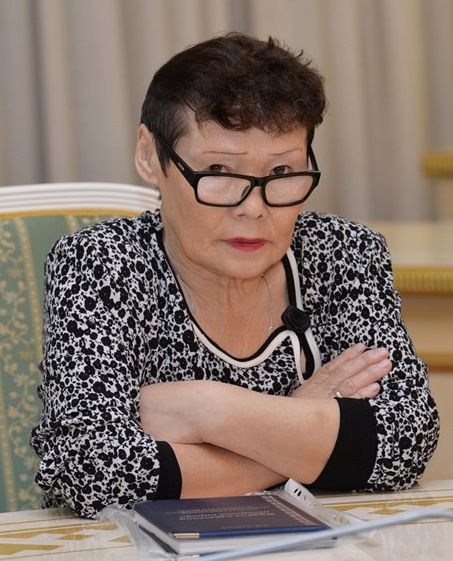
Image caption: 'Anna Nerkagi,' Famous Fix. URL: https://www.famousfix.com/topic/anna-nerkagi, accessed 27 may 2026.
References
- Douglas, M. (1966). Purity and Danger: An Analysis of Concepts of Pollution and Taboo. London: Routledge & Kegan Paul.
- Drozhashchikh, N.V. (ed.) (2021). Chelovek Severa v polikul’turnom i perevodcheskom prostranstve: tvorcheskoe nasledie Anny Nerkagi [Northern Indigenous People in a Multicultural and Translational Space: The Creative Legacy of Anna Nerkagi]. Tyumen: Tyumen State University Press.
- Glavatskaya, E. (2016). Polygamy among indigenous people of northern West Siberia in ethnographic and early census materials. The History of the Family, 21(1), 87-100.
- Golovnev, A.V., & Osherenko, G. (2018). Siberian Survival: The Nenets and Their Story. Ithaca-London: Cornell University Press.
- Karpov V.P., Gavrilova N.Yu., Gerasimova G.I. (2018). Sotsializm v tundre: nentsy-kochevniki Yamala na volnakh sovetskoi severnoi politiki v 1930-e — 1980-e gody [Socialism in the Tundra: Nenets-Nomads of Yamal on the Waves of Soviet Northern Policy in the 1930–1980’s]. Noveishaia istoriia Rossii, 8(3), 679–690.
- Khristoforova, O.B. (2008). “U menia est’ slovo”: traditsionnyi rechevoi etiket i problemy etnicheskogo samosoznaniia v avtorskikh tekstakh [“I Have the Word”: Traditional Speech Etiquette and the Problems of Ethnic Self-Awareness in Authorial Texts]. Vestnik RGGU. Seriia: Literaturovedenie, Iazykoznanie, Kul’turologiia, 9. https://cyberleninka.ru/article/n/u-menya-est-slovo-traditsionnyy-rechevoy-etiket-i-problemy-etnicheskogo-samosoznaniya-v-avtorskih-tekstah-1 (accessed 10 December 2025).
- Khristoforova, O.B. (2023). Mify severnykh narodov Rossii: ot tvortsa Numa i vorona Kutha do demonov kulei i zlykh dukhov Kana [Myths of the Northern Peoples of Russia: From the Creator Numa and the Raven Kutha to the Demons Kulei and the Evil Spirits Kana]. Moscow: Mann, Ivanov i Ferber.
- Koneva A.A. (2016). Obraz materi v povestyakh A. P. Nerkagi “Aniko iz roda Nogo” i “Ilir” [The image of the mother in the stories of A. P. Nerkagi «Aniko of the Nogo Clan» and «Ilir»]. In Pravoslavnye istoki russkoi kul’tury i slovesnosti [Orthodox Sources of Russian Culture and Literature], pp. 103-106. Tyumen: Tyumen State University Press.
- Lagunova, O.K. (2007). Fenomen tvorchestva russkoiazychnykh pisatelei nentsev i khantov poslednei treti XX veka (E. Aipin, Iu. Vella, A. Nerkagi) [The Phenomenon of Russian-Language Nenets and Khanty Writing in the Last Third of the 20th Century (E. Aipin, Yu. Vella, A. Nerkagi)]. Tyumen: Tyumen State University Press.
- Liarskaya, E. (2010). Women and the tundra: Is there a gender shift on Yamal? Anthropology of East European Review, 28, 51-84.
- Liarskaya, E. (2013). Boarding school on Yamal: History of development and current situation. In E. Kasten & T. de Graaf (Eds.), Sustaining Indigenous Knowledge: Learning Tools and Community Initiatives for Preserving Endangered Languages and Local Cultural Heritage, 159-180. Fürstenberg/Havel: Kulturstiftung Sibirien.
- Morgun, E. (2022). Ekologicheskoe vospitanie v usloviyakh kochevogo obrazovaniya: sravnitel’nyi analiz opyta shkol Yamala [Ecological Education in the Context of Nomadic Schooling: A Comparative Analysis of Educational Practices in Yamal]. Kazanskii pedagogicheskii zhurnal, 2, 9-18.
- Nerkagi, A. (1996). Molchashchii. Tyumen: SoftDizain.
- “Nerkagi Anna Pavlovna” (2025). Elektronnaya biblioteka tyumenskogo pisatelya. https://writer-tyumen.ru/index.php?m=autor&aid=139 (accessed 12 December 2025).
- Rogachev, V.A. (1996). Genii chistoi krasoty. Kritiko-biograficheskii ocherk tvorchestva Anny Nerkagi [A Genius of Pure Beauty: A Critical and Biographical Essay on the Work of Anna Nerkagi]. In A. Nerkagi, Molchashchii, Tyumen: SoftDizain, 405-414.
- Samson Normand de Chambourg, D. (2003). La Passion de l’Homme selon Anna Nerkagui. Slovo: Sibérie. Paroles et mémoires, (A.-V. Charrin, dir.), Paris, Publications Langues’O / C.R.R.E.A., vol. 28-29, 41-76.
- Zhuleva, A.S. (2019). Mifopoeticheskaya model’ mira v nenetskoi literature. Moscow: IMLI RAN.