
Staying on the Mountain: Women, Memory, and the Transformation of Remoteness in Rural Romania
 Oana-Alexandra Borlea Stancioi
Published 2026-11-28
Keywords
- remoteness,
- lived experience,
- transformations,
- women's memory,
- Romania
Copyright (c) 2026 Oana-Alexandra Borlea Stancioi (Author)

This work is licensed under a Creative Commons Attribution-NonCommercial-NoDerivatives 4.0 International License.
How to Cite
Abstract
This paper focuses on the lived experience of women in a remote mountain community in rural Romania. From working as hard as the men to being the ones remaining on the mountain year long, they have been described as the ones who hold the community together. In a settlement that is simultaneously hard to reach and widely sought after by tourists and lifestyle migrants, these women manoeuvre restrictions and reclaim their agency through mutual support, resilience and (re)tellings of their life stories.
Using remoteness as a lens, my research explores how it shapes everyday life and social practice. Drawing on ongoing ethnographic fieldwork, I examine how transformations are reflected in local women’s perceptions of remoteness. As a relational and affective category, it is also present in how they remember, reinterpret, preserve, and perform their day-to-day realities.
Approaching this through the concept of matriculture, the study highlights how seemingly stereotypical social roles are generated, reproduced, and transformed, bringing to light the often silenced or under-acknowledged contribution of women to the community. Situated in the wider Eastern-European context, these preliminary findings highlight experiences of women in relation to cultural change and identity in post-socialist rural societies.
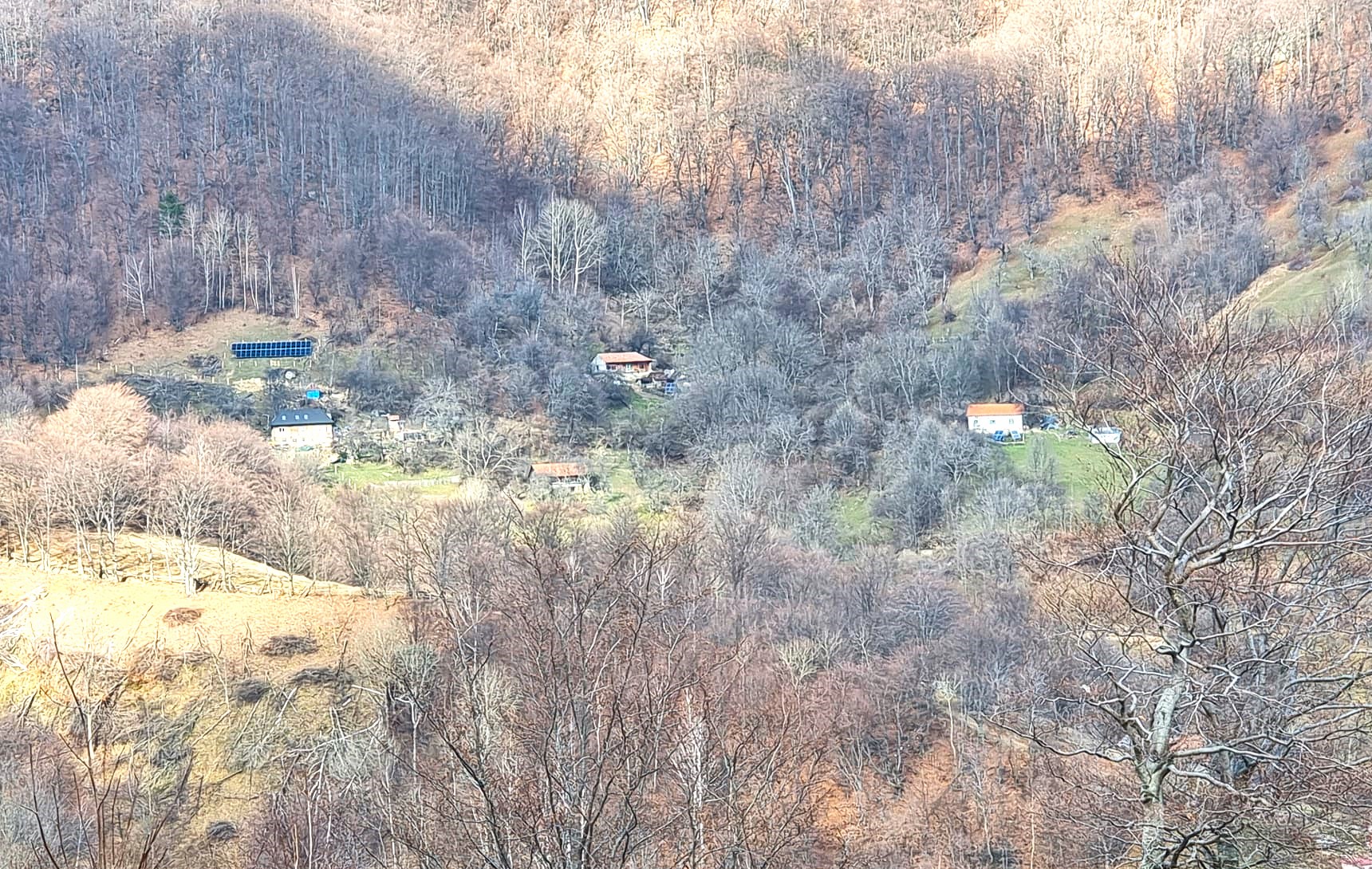
Image caption: Overview of a hamlet in Romania. © Borlea-Stancioi, 2026.
References
- Agárdi, I. (2022). On the verge of history: Life stories of rural women from Serbia, Romania, and Hungary, 1920–2020 (Kindle ed., Vol. 241). Ibidem Verlag.
- Comisia Națională de Strategie și Prognoză. (2024). Economia județului Caraș-Severin. https://cnp.ro/wp-content/uploads/2025/05/Economia-judetului-Caras-Severin.pdf. Original access date unrecorded; verified 22 October 2026.
- Drazin, A. 2018. ‘The Fitness of Persons in the Landscape: Isolation, Belonging and Emergent Subjects in Rural Ireland.’ Social Anthropology / Anthropologie Sociale 26 (4): 535–549. DOI: https://doi.org/10.1111/1469-8676.12521. Accessed 4 April 2022. Page citations refer to the author’s accepted manuscript available at https://discovery.ucl.ac.uk/id/eprint/10051104/.
- Driessen, M. (2018). ‘Rural voids.’ Public Culture, 30(1), 61–84. https://doi.org/10.1215/08992363-4189167 Accessed 4 September 2022.
- Dzenovska, D. (2020). ‘Emptiness: Capitalism without people in the Latvian countryside.’ American Ethnologist, 47(1), 10–26. https://doi.org/10.1111/amet.12867. Verified 22 October 2026.
- Geertz, C. (1973). The interpretation of cultures. Basic Books.
- Goina, C. (2024). Parallel lives: An empirical exploration of the concept of generation. Springer Nature Switzerland. https://doi.org/10.1007/978-3-031-75464-7
- Guédon, M-F (2020), ‘Introduction,’ Matrix: A Journal for Matricultural Studies 1(1) (May 2020): 3–7; https://www.networkonculture.ca/activities/matrix/issues/vol1_iss1; Accessed 29 October 2026.
- Günel, G., & Watanabe, C. (2024). ‘Patchwork ethnography.’ American Ethnologist, 51(1), 131–139. https://doi.org/10.1111/amet.13243 Accessed 5 December 2025.
- Harms, E., Hussain, S., Newell, S., et al. (2014). ‘Remote and edgy: New takes on old anthropological themes.’ HAU: Journal of Ethnographic Theory, 4(1), 361–381. https://doi.org/10.14318/hau4.1.020; Accessed 19 November 2022.
- Hockey, J., & Forsey, M. (2012). ‘Ethnography is not participant observation: Reflections on the interview as participatory qualitative research.’ In J. Skinner (Ed.), The interview: An ethnographic approach (pp. 69–88). Bloomsbury Academic.
- Honoré, C. (2004). In praise of slowness: Challenging the cult of speed. HarperSanFrancisco.
- Hurubean, A. (coord.). (2015). Statutul femeii în România comunistă: Politici publice și viață privată. Iași: Institutul European.
- Institutul Național de Statistică. (2023). ‘Populația rezidentă pe sexe, județe, municipii, orașe, comune și sate, la 1 decembrie 2021’ (Tabel 1.22) [Data set]. Recensământul populației și locuințelor 2021, rezultate definitive. https://www.recensamantromania.ro/wp-content/uploads/2023/05/Tabel-1.22.xlsx Original access date unrecorded; saved copy verified 25 October 2026.
- Kligman, Gail, and Katherine Verdery. Peasants under Siege: The Collectivization of Romanian Agriculture, 1949-1962. Princeton University Press, 2011.
- Marcus, G. E. (1995). ‘Ethnography in/of the world system: The emergence of multi-sited ethnography.’ Annual Review of Anthropology, 24(1), 95–117. https://doi.org/10.1146/annurev.an.24.100195.000523. Accessed 5 August 2025
- Mihăilescu, V. (Ed.). (2017). De ce este România astfel? Avatarurile excepționalismului românesc. Polirom.
- Munteanu, I. (2007). Banatul istoric: 1867–1918. Vol. II: Ocupații. Economia. Editura Excelsior Art.
- Podjed, D., & Peternel, L. (2024). ‘The power of isolation.’ Traditiones, 53(2), 7–17. https://doi.org/10.3986/Traditio2024530201 Accessed 29 July 2026.
- Bolovan, I., & Gräf, R. (Eds.). (2023). O istorie a Banatului: Compendiu (2nd rev. ed.). Editura Școala Ardeleană; Academia Română, Centrul de Studii Transilvane.
- Rowlatt, L., & Guedon, M.-F. (2025). ‘Women and water: The flow of matricultures. Introduction (English).’ Matrix: A Journal for Matricultural Studies, 4(1), 1–4; https://doi.org/10.60676/5z1ydg64. Original access date unrecorded; verified 22 October 2026.
- Schweitzer, P., & Povoroznyuk, O. (2019). ‘A right to remoteness? A missing bridge and articulations of indigeneity along an East Siberian railroad.’ Social Anthropology, 27(2), 236–252. https://doi.org/10.1111/1469-8676.12648. Accessed 19 November 2022.
- Rusnac, M. (2025, June 7). ‘Data de 13 iunie în istoria Mehadiei.’ Istoria Banatului. https://istoriabanatului.wordpress.com/2025/06/07/mircea-rusnac-data-de-13-iunie-in-istoria-mehadiei/ Original access date unrecorded; verified 25 October 2026.
- Scott, J. C. (2009). The art of not being governed: An anarchist history of upland Southeast Asia. Yale University Press.
- Shore, C., & Wright, S. (1997). ‘Policy: A new field of anthropology.’ In C. Shore & S. Wright (Eds.), Anthropology of policy: Critical perspectives on governance and power (pp. 3–39). Routledge.
- Stoica de Hațeg, N. (1981). Cronica Banatului (D. Mioc, Ed.; 2nd rev. ed.). Facla.
- Tîrcovnicu, V. (1970). Contribuții la istoria învățămîntului românesc din Banat (1780–1918). București: Editura Didactică și Pedagogică.
- Umbres, R. (2022). Living with distrust: Morality and cooperation in a Romanian village. Oxford University Press.
- Uusitalo, E., & Assmuth, L. (2013). ‘Having, loving, being in the periphery: Interpretations of locality in the national landscape of Koli, Eastern Finland.’ In L. Silva & E. Figueiredo (Eds.), Shaping rural areas in Europe: Perceptions and outcomes on the present and the future (pp. 57–73). Springer. https://doi.org/10.1007/978-94-007-6796-6_5. Accessed 12 August 2024.