

Published 2026-11-28
Keywords
- Nigerian matriculture,
- visual art practice,
- cultural symbolism,
- women and social transformation,
- arts-based research
Copyright (c) 2026 Etim Ekpenyong Mfon (Author)

This work is licensed under a Creative Commons Attribution-NonCommercial-NoDerivatives 4.0 International License.
How to Cite
Abstract
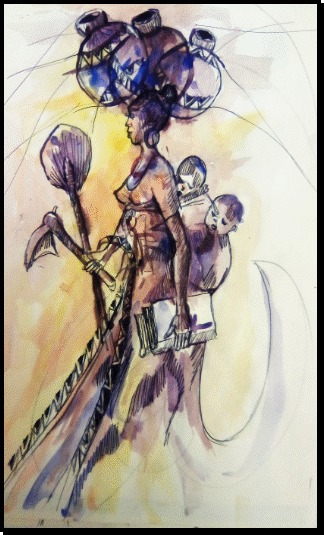
The purpose of the article is to examine studio-based visual arts as a venue for social awareness and cultural transformation with regard to the concept of matriculture. In this case, the notion of matriculture is broadened from its ethnographic context to include visual arts as symbolic practice, in which meanings of women are symbolized and reworked. Eight paintings, made in the period from 2007 until 2026 and based on Etimpaste, an eco-conscientious material created by means of the research, are analysed. In early paintings, including Milk Maids, Fruit-bearer, and Beauty in Diversity, textured surface highlights reproductive, domestic, and informal work of women and their impact on community life. In later paintings, including Hands That Hold the Earth, Bearer of Worlds, Threads of Memory, and Rewriting the Frame, the use of diluted Etimpaste helps to analyse issues of fluidity, interdependence, memory, ecology and transformation. Mainly, the research is based on matriculture, while an ecofeminist view provides ecological support. Thus, medium and message are shown to be connected to each other.
Image caption: Bearer of Worlds, Etim Ekpenyong Mfon (this article).
References
- Barad, K. (2007). Meeting the Universe Halfway: Quantum physics and the entanglement of matter and meaning. Duke University Press.
- Barrett, E., & Bolt, B. (Eds.). (2007). Practice as Research: Approaches to creative arts enquiry. I.B. Tauris.
- Bennett, J. (2010). Vibrant Matter: A political ecology of things. Duke University Press.
- Candy, L., & Edmonds, E. (2018). Practice-based Research in the Creative Arts: Foundations and futures from the front line. Leonardo, 51(1), 63–69. https://doi.org/10.1162/LEON_a_01471
- Crenshaw, K. (1989). ‘Demarginalizing the intersection of race and sex: A Black feminist critique of antidiscrimination doctrine, feminist theory and antiracist politics.’ University of Chicago Legal Forum, 1989 (1), 139–167.
- Federici, S. (2012). Revolution at Point Zero: Housework, reproduction, and feminist struggle. PM Press.
- Fraser, N. (2016). ‘Contradictions of Capital and Care.’ New Left Review, 100, 99–117.
- Gablik, S. (1991). The Reenchantment of Art. Thames & Hudson.
- Geertz, C. (1973). The Interpretation of Cultures. Basic Books.
- Guédon, M.-F. (n.d.). Matriculture: Conceptual framework and applications: Call for papers. International Network for Training, Education, and Research on Culture.
- Ingold, T. (2013). Making: Anthropology, archaeology, art and architecture. Routledge.
- Kagan, S. (2011). Art and Sustainability: Connecting patterns for a culture of complexity. transcript Verlag.
- Mbembe, A. (2001). On the Postcolony. University of California Press.
- Mulvey, L. (1975). ‘Visual pleasure and narrative cinema.’ Screen, 16(3), 6–18. https://doi.org/10.1093/screen/16.3.6
- Nnaemeka, O. (2004). ‘Nego-feminism: Theorizing, practicing, and pruning Africa’s way.’ Signs, 29(2), 357–385.
- Oyěwùmí, O. (1997). The Invention of Women: Making an African sense of Western gender discourses. University of Minnesota Press.
- Plumwood, V. (1993). Feminism and the Mastery of Nature. Routledge.
- Shiva, V. (1988). Staying Alive: Women, ecology, and development. Zed Books.
- Smith, H., & Dean, R. T. (Eds.). (2009). Practice-led Research, Research-led Practice in the Creative Arts. Edinburgh University Press.
- Sullivan, G. (2010). Art Practice as Research: Inquiry in the visual arts (2nd ed.). SAGE Publications.