
Une intensité sonore autorisée: la tzaghrīta comme système matriculturel chez les femmes Jebala
 Hicham Chami
Publié 2026-11-28
Mots-clés
- ululation,
- culture Jebala,
- voix des femmes,
- tzaghrīta,
- nord du Maroc
© Hicham Chami (Author) 2026

Cette œuvre est sous licence Creative Commons Attribution - Pas d'Utilisation Commerciale - Pas de Modification 4.0 International.
Comment citer
Résumé
La tzaghrīta (ululation) est souvent décrite dans la littérature comme une pratique vocale ritualisée et empreinte d’affectivité, exprimant la joie lors d’événements liés au cycle de la vie ou à la vie communautaire. De tels cadres d’analyse ont toutefois tendance à laisser dans l’ombre les conventions culturelles spécifiques qui façonnent les formes, les contextes et les significations de la présence vocale des femmes dans l’espace public.
Cet article soutient que, chez les femmes Jebala du nord du Maroc, la tzaghrīta fonctionne selon une logique matriculturelle : elle organise la manière dont les femmes expriment collectivement leurs affects et négocient les normes de convenance, les rapports d’autorité et leur présence dans l’espace public. La force expressive de la tzaghrīta repose sur des formes d’autorisation propres à cette culture, qui rendent possible l’intensité vocale des femmes tout en en définissant les limites.
Cette thèse est développée à travers une analyse de la tzaghrīta telle qu’elle se manifeste dans les rituels liés au cycle de la vie, les rassemblements communautaires et les interactions sociales quotidiennes chez les Jebala, en s’appuyant sur des observations ethnographiques et des récits historiques propres à cette région. Une attention particulière est portée aux conventions de participation, aux modes de circulation de cette pratique, ainsi qu’aux vocabulaires moraux locaux liés à la modestie, au décorum et à la retenue vocale. Inscrire la tzaghrīta dans un cadre matriculturel localisé permet de comprendre comment les voix des femmes acquièrent une force culturelle au sein d’ordres symboliques établis, et comment cette force s’inscrit dans l’organisation plus large des rapports sociaux de genre dans la région des Jebala. (en anglais)
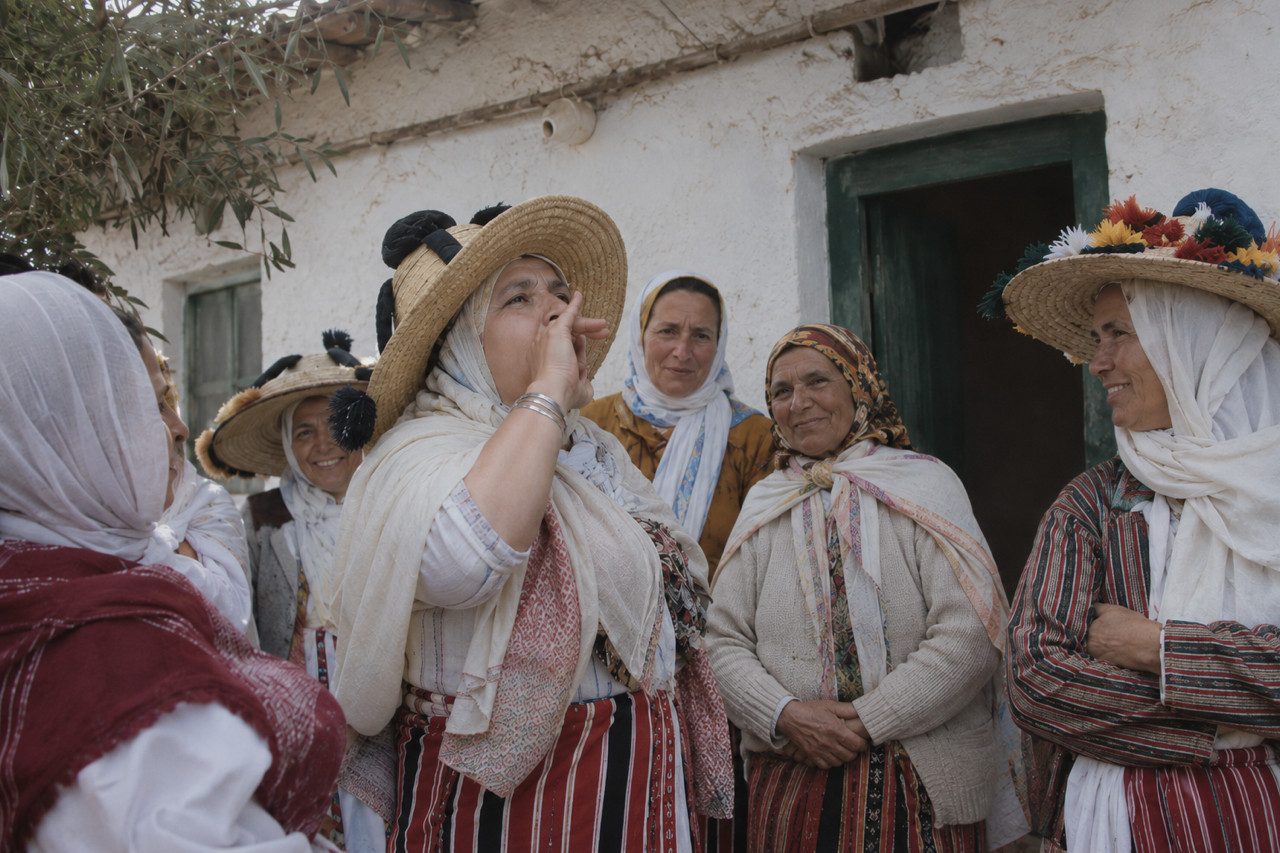
Légende de l’image : Une femme effectuant tzaghrīta (ululation) parmi un rassemblement de femmes à Dǝwwār Būnṭāyǝr, sur le territoire de la tribu Lakhmās, au sud-est de Chefchaouen, dans le nord du Maroc, juin 2019. © Abdou El Ouahabi, utilisé avec permission.
Références
- Abderrazaq, Hala Ahmed. 2015. “Dawr Al-Mar’a l-Filisṭīnīya Fī Ḥarakat l-Kifāḥ l-Waṭanī 1936 - 1938 [Tr. Palestinian Women in the National Struggle Movement, 1936–1938].” Majallat Buḥūth Ash-Sharq l-Awsaṭ Fīl-ʻulūm al-Insānīyah Wal-Adabīyah, no. 37: 387–412.
- Abu-Lughod, Lila. 2002. 'Do Muslim Women Really Need Saving? Anthropological Reflections on Cultural Relativism and Its Others.' American Anthropologist civ: 783–90.
- Adilah, Muatasim, and Houssaine Daraouiche. 2012. Fann Az-Zaghārīd Ash-Shaʿbīya Fīl-Aʿrās al-Filisṭīnīya: Dirāsa Ethnūmiyūsīkūlūjīya Balāghīya [The Art of Ululations in Palestinian Weddings: A Rhetorical Ethnomusicological Study]. Diyār lin-nashr.
- Afsaruddin, Asma. 1999. 'Introduction: The Hermeneutics of Gendered Space and Discourse.' In Hermeneutics and Honor: Negotiating Female “Public” Space in Islamic/ate Societies, edited by Asma Afsaruddin. Harvard University Press.
- Ahmed, Leila. 1992. Women and Gender in Islam: Historical Roots of a Modern Debate. Yale University Press.
- Al Attari, Husseyn Salim. 2017. Silsilat Aghānī Ad-Dabka l-Filisṭīnīyya [The Palestinian Dabke Song Series]. ar-Raqmiyya.
- Al Bakr, Mahmouf Mouflih. 2014. Urjūzat Al-Mar’a Fī Bilād Ash-Shām, “al-Muhāhāh”: Dirāsa. [Women’s Work Songs in the Levant: A Study of al-Muhāhāh]. al-Hay’a al-ʿāmma as-sūriya lil-kitāb.
- Badran, Margot. 2009. Feminism in Islam: Secular and Religious Convergences. OneWorld.
- Baker, Alison. 1998. Voices of Resistance: Oral Histories of Moroccan Women. State University of New York Press.
- Ciucci, Alessandra M. 2010. 'De-Orientalizing the ‘Aita and Re-Orientalizing the Shikhat.' In French Orientalism: Culture, Politics, and the Imagined Other, edited by Desmond Hosford and Chong J. Wojtkowski. Cambridge Scholars Publishing.
- Combs-Schilling, Margaret Elaine. 1989. Sacred Performances: Islam, Sexuality, and Sacrifice. Columbia University Press.
- Curtis, Maria F. 2015. '“I Have a Voice”: Despatialization, Multiple Alterities and the Digital Performance of Jbala Women of Northern Morocco.' Hawwa: Journal of Women of the Middle East and the Islamic World xiii (3): 323–43.
- Drif, Zohra. 2013. Mémoires d’une Combattante de l’ALN [Memoirs of an ALN Woman Combatant]. Chihab.
- Ensel, Remo. 1999. Saints and Servants in Southern Morocco. E. J. Brill.
- Esposito, John L. 2004. The Oxford Dictionary of Islam. Oxford University Press.
- Fernea, Elizabeth Warnock. 1975. A Street in Marrakech: A Personal View of Urban Women in Morocco. Doubleday.
- Geertz, Clifford. 1973. 'Thick Description: Toward an Interpretative Theory of Culture.' In The Interpretation of Cultures. Basic Books.
- Guédon, Marie-Françoise. 2020. 'Introduction.' Matrix: a Journal for Matricultural Studies i (1): 3–7.
- Hasso, Frances S., and Zakia Salime. 2016. Freedom without Permission: Bodies and Space in the Arab Revolutions. Duke University Press.
- Jacobs, Jennifer E. 2007. '“Unintelligibles” in Vocal Performances at Middle Eastern Marriage Celebrations.' Text & Talk - An Interdisciplinary Journal of Language, Discourse & Communication Studies xxvii (4): 483–507.
- _______. 2008. 'Ululation in Levantine Society: The Cultural Reproduction of an Affective Vocalization.' PhD dissertation, University of Pennsylvania.
- Jones, Lura JaFran. 2001. 'Women and Music around the Mediterranean.' In Women and Music: A History, 2nd ed., edited by Karin Anna Pendle. Indiana University Press.
- Kapchan, Deborah Anne. 1994. 'Moroccan Female Performers Defining the Social Body.' Journal of American Folklore cvii: 82–105.
- _______. 2003. 'Nashat: The Gender of Musical Celebration in Morocco.' In Music and Gender: Perspectives from the Mediterranean, edited by Tullia Magrini. University of Chicago Press.
- Kuipers, Joel C. 1999. 'Ululations from the Weyewa Highlands (Sumba): Simultaneity, Audience Response, and Models of Cooperation.' Ethnomusicology xliii: 490–507.
- Lane, Edward William. 1871. An Account of the Manners and Customs of the Modern Egyptians: The Definitive 1860 Edition, Vol. II. John Murray.
- Mahmood, Saba. 2005. Politics of Piety: The Islamic Revival and the Feminist Subject. Princeton University Press.
- Meintjes, Louise. 2019. 'Ululation.' In Remapping Sound Studies, edited by Gavin Steingo and Jim Sykes. Duke University Press.
- Nasrallah, Ibrahim. 1990. Zaghārīd L-ʿurs al-Urdunī [Ululations at Jordanian Weddings]. Dār ash-shurūq lin-nashr wat-tawzīʿ.
- Ossman, Susan. 1994. Picturing Casablanca: Portraits of Power in a Modern City. University of California Press.
- Qissis-Nafl, Nuha. 2010. Farḥat Al-Aghānī Ash-Shaʿbīya l-Flisṭīnīyya [Festive Traditions in Palestinian Folk Song]. Dār ward lin-Nashr wat-tawzīʿ.
- Ramadan, Mohammed Khalid. 2009. Zaghrūda: Dirāsāt Fīz-Zaghrūda Ash-Shaʿbīya as-Sūrīyya [Ululation in Syrian Folk Culture: A Study]. Manshūrāt wizārat ath-thaqāfa.
- _______. 2015. Al-Alwān Fīt-Turāth Ash-Shaʿbī Ash-Shifāhī: Dirāsa [Typologies of Oral Folk Heritage]. al-Hay’a al-ʿāmma as-Sūriya lil-kitāb.
- Rovsing Olsen, Miriam. 2013. 'A Common Motivation—A Specific Style for Each Culture: Towards a Comparison of Wedding Rituals in Morocco.' Yearbook for Traditional Music xlv: 164–86.
- Rowlatt, Linnéa. 2020. 'Blind: the Western Gaze at Matricultures, Historically. Part 1.' Matrix: a Journal for Matricultural Studies i (1): 15-28.
- Sambron, Diane. 2008. Femmes Musulmanes : Guerre d’Algérie 1954-1962 [Muslim Women and the Algerian War, 1954–1962]. Autrement.
- Saoudi, Yasmina. 2018. “Ṣuwar Min Ṣumūd Al-Mar’a l-Jazā’irīya Bil-Wilāya Ath-Thālitha Athnā’ Ath-Thawra at-Taḥrīrīya Min Khilāl Mudhakkirāt Djoudi Attoumi [Tr. Representations of Algerian Women’s Resilience in the Third Wilaya during the Liberation War: A Reading of Djoudi Atoumi’s Memoirs].” Majallat Āfāq Lil-ʿulūm iii (1): 103–12.
- Trevisan Semi, Emanuela. 2009. 'El próximo año en... Ouazzane: usos socioculturales del culto de un santo judío.' Quaderns de la Mediterrània xii (Special issue: Espiritualidades y Representaciones en el diálogo intercultural): 212–18.
- Westermarck, Edward Alex. 1914. Marriage Ceremonies in Morocco. MacMillan & Co.
- (originals below in Arabic / originaux en arabe ci-dessous)
- ʿAbd ar-Rāziq, Hāla Aḥmad. 2015. “Dawr al-mar’a al-filisṭīnīya fī ḥarakat al-kifāḥ al-waṭanī 1936–1938 [Tr. The Role of Palestinian Women in the National Struggle Movement, 1936–1938].” Majallat Buḥūth ash-sharq l-awsaṭ fīl-ʻulūm al-insānīyah wal-adabīyah, no. 37: 387–412.
- ʿAdīla, Muʿtaṣim and Ḥusayn ad-Darāwīsh. 2012. Fann az-zaghārīd ash-shaʿbīya fīl-aʿrās al-filisṭīnīya: dirāsa ithnūmiyūsīkūlūjīya balāghīya [Tr. The Art of Ululations in Palestinian Weddings: A Rhetorical Ethnomusicological Study]. Diyār lin-nashr.
- ʿAṭṭārī (al-), Ḥusayn Salīm. 2017. Silsilat aghānī ad-dabka al-filisṭīnīyya [Tr. The Palestinian Dabke Song Series]. Ar-Raqmiyya.
- Bakr (al-), Maḥmūd Mufliḥ. 2014. Urjūzat al-mar’a fī bilād ash-shām, “al-Muhāhāh”: dirāsa. [Tr. Women’s Work Songs in the Levant: A Study of al-Muhāhāh]. al-Hay’a al-ʿāmma as-Sūriya lil-kitāb.
- Naṣrallāh, Ibrāhīm. 1990. Zaghārīd l-ʿurs al-urdunī [Tr. Ululations at Jordanian Weddings]. Dār ash-Shurūq lin-nashr wat-tawzīʿ.
- Qissīs-Nafl, Nuhā. 2010. Farḥat al-aghānī ash-shaʿbīya al-filisṭīnīyya [Tr. Festive Traditions in Palestinian Folk Song]. Dār Ward lin-nashr wat-tawzīʿ.
- Ramaḍān, Muḥammad Khālid. 2009. Zaghrūda: dirāsāt fīz-zaghrūda ash-shaʿbīya as-sūrīyya [Tr. Ululation in Syrian Folk Culture: A Study]. Manshūrāt wizārat ath-thaqāfa.
- _______. 2015. al-Alwān fīt-turāth ash-shaʿbī ash-shafahī: dirāsa [Tr.: Typologies of Oral Folk Heritage]. al-Hay’a al-ʿāmma as-Sūriya lil-kitāb.
- Saʿūdī, Yasmīna. 2018. “Ṣuwar min ṣumūd al-mar’a l-jazā’irīya bil-wilāya ath-thālitha athnā’ ath-thawra at-taḥrīrīya min khilāl mudhakkirāt Djoudi Attoumi [Tr. Representations of Algerian Women’s Resilience in the Third Wilaya during the Liberation War: A Reading of Djoudi Atoumi’s Memoirs].” Majallat Āfāq lil-ʿulūm, iii (1): 103–12.