
La maternité dans Murzilka: la construction d’idéaux maternels pour les enfants soviétique, 1956 - 1964
Publié 2026-11-28
Mots-clés
- magazines soviétiques pour enfants,
- Maternité,
- Double fardeau,
- Fémininité,
- Matriculture
© Helen Lachal (Author) 2026

Cette œuvre est sous licence Creative Commons Attribution - Pas d'Utilisation Commerciale - Pas de Modification 4.0 International.
Comment citer
Données de Fonds
Résumé
Le projet soviétique reposait sur le fait que ses citoyens deviennent parents, en particulier après les pertes humaines massives subies pendant la Grande Guerre patriotique. Non seulement les citoyens soviétiques devaient avoir des enfants, mais Ils devaient également les élever correctement et leur inculquer les valeurs de citoyens soviétiques. Cet article porte sur la représentation de la maternité dans le magazine populaire soviétique pour enfants Murzilka entre 1956 et 1964, ainsi que sur le rôle de ces mères en tant que transmettrices de la matriculture. Il identifie des modèles particuliers de maternité (mères tendres et aimantes; mères qui travaillent; mères surchargées; mères défaillantes) et examine comment ces modèles étaient dépeints dans les histoires, les poèmes, les illustrations et les lettres de lecteurs, ainsi que la façon dont sont représentées leurs interactions avec leurs enfants.
En dépeignant des mères, qu’elles soient exemplaires ou non, Murzilka cherchait non seulement à influencer ses jeunes lecteurs, futurs parents, mais aussi les parents de ces enfants, qui lisaient peut-être avec eux ou leur faisaient la lecture. Quelles versions de la maternité le magazine présentait-il à ses lecteurs et comment ces modèles idéalisés, et parfois problématisés, ont-ils servi d’agents de diffusion de la matriculture? (en anglais)
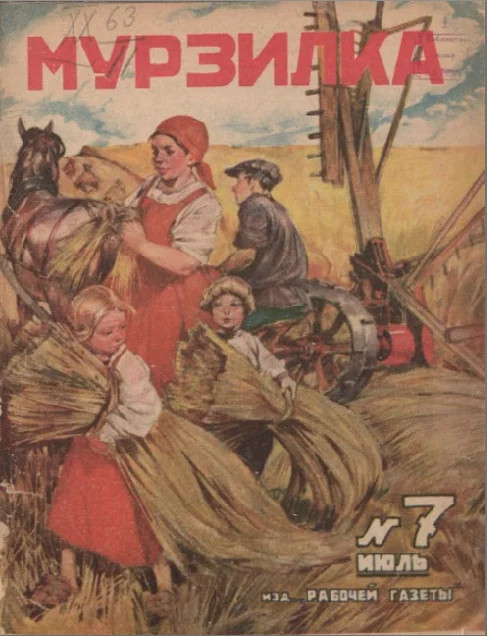
Légende de l’image : Couverture de Murzilka n° 7 (Portada de Murzilka), de Montserrat Sáenz González, ‘Propaganda y educación sobre igualdad de género y su influencia en la participación de las mujeres en el Ejército Rojo de la Unión Soviética durante la Segunda Guerra Mundial’ (Propagande et éducation en matière d’égalité des sexes, et leur influence sur la participation des femmes à l’Armée rouge de l’Union soviétique durant la Seconde Guerre mondiale), Investigationes Históricas. Poca Moderna y Contemporánea, 42 (2022): 1111-1144; disponible sous licence: Creative Commons Attribution - NonCommerciale 4.0 International [accédé 27 Nov 2026].
Références
- Murzilka digital archive of the Rossiiskaia gosudarstvennaia detskaia biblioteka (Russian State Children’s Library) https://nebdeti.ru/magazines/magazine?scope=cd39c5df-ed7c-409d-b46c-54bf03a1c380
- Ogonek
- Pravda
- Rabotnitsa
- Rossiiskii gosudarstvennyi arkhiv literatury i iskusstva (Russian State Archive of Literature and Art) (RGALI), f. 631, op. 36, d. 105: Transcript of a May 1951 meeting of the children’s literature section of the Union of Writers of the USSR. Rossiiskii gosudarstvennyi arkhiv sotsial'no-politicheskoi istorii (Russian State Archive of Socio-Political History) (RGASPI), f. M81, op. 1, d. 20, l. 2: letter dated 1964 signed by Murzilka editor A. Mitiaev.
- Attwood, Lynne. The New Soviet Man and Woman: Sex-Role Socialization in the USSR. Macmillan, 1990.
- Attwood, Lynne. Creating the New Soviet Woman: Women’s Magazines as Engineers of Female Identity, 1922–53. Macmillan, 1999.
- Attwood, Lynne. ‘Celebrating the ‘Frail-Figured Welder’: Gender Confusion in Women’s Magazines of the Khrushchev Era.’ Slavonica 8, no. 2 (2002): 159–177.
- Bartlett, Djurdja. Ideology and Clothes: The Rise and Decline of Socialist Official Fashion. PhD Thesis, (University of the Arts, London, 2006).
- Batchen, Geoffrey. Negative/Positive: A History of Photography. (Routledge, 2020).
- Bonnell, Victoria E. ‘The Peasant Woman in the Stalinist Political Art of the 1930s.’ In The Aesthetic Arsenal: Socialist Realism under Stalin, edited by Matthew Cullerne Bown and Brandon Taylor, 140–56. Yale University Press, 1993.
- Bonnell, Victoria E. Iconography of Power: Soviet Political Posters Under Lenin and Stalin University of California Press, 1999.
- Budig, Michelle. ‘Feminism and the Family.’ In The Blackwell Companion to the Sociology of Families, edited by Jacqueline Scott, Judith Treas, and Martin Richards, Blackwell, 2004.
- Clark, Katerina, The Soviet Novel: History as Ritual. University of Chicago Press, 1981.
- Clements, Barbara Evans. A History of Women in Russia: From Earliest Times to the Present. Indiana University Press, 2012.
- Delaney, Caitriona, Alicja Bobek, and Sara Clavero. ‘‘It Was Too Much for Me’: Mental Load, Mothers, and Working from Home during the COVID-19 Pandemic.’ Frontiers in Psychology 14 (2023): 1-12.
- Denisova, Liubov. Rural Women in the Soviet Union and Post-Soviet Russia. Edited and translated by Irina Mukhina. Routledge, 2010.
- Dodge, Norton T., and Murray Feshbach. ‘The Role of Women in Soviet Agriculture.’ In Soviet and East European Agriculture, edited by Jerzy F. Karcz. University of California Press, 1967.
- Filtzer, David. ‘Women Workers in the Khrushchev Era.’ In Women in the Khrushchev Era, edited by Melanie Ilič, Susan E. Reid, and Lynne Attwood. Palgrave Macmillan, 2004.
- Fitzpatrick, Sheila. Stalin’s Peasants: Resistance and Survival in the Russian Village after Collectivization. Oxford University Press, 1994.
- Fitzpatrick, Sheila. A Spy in the Archives: A Memoir of Cold War Russia. Melbourne University Press, 2013.
- Geertz, Clifford. The Interpretation of Cultures: Selected Essays. Basic Books, 1973.
- Glickman, Rose L. Russian Factory Women: Workplace and Society, 1880–1914. University of California Press, 1984.
- Goldman, Wendy Z. Women at the Gates: Gender and Industry in Stalin’s Russia. Cambridge University Press, 2002.
- Guédon, Marie-Françoise. ‘Introduction.’ Matrix: A Journal for Matricultural Studies 1, no. 1 (2020): 3–7. URL: https://www.networkonculture.ca/activities/matrix/issues/vol1_iss1 , accessed 3 October 2026.
- Gronow, Jukka and Sergei Zhuravlev. Fashion Meets Socialism: Fashion Industry in the Soviet Union after the Second World War. Finnish Literature Society, 2015.
- Gurova, Olga. ‘The Art of Dressing: Body, Gender, and Discourse on Fashion in Soviet Russia in the 1950s and 1960s.’ In The Fabric of Cultures: Fashion, Identity, and Globalization, edited by Eugenia Paulicelli and Hazel Clark, 73–91. Routledge, 2009.
- Harden, Jeni. ‘Beyond the Dual Burden: Theorising Gender Inequality in Soviet Russia.’ Critique: Journal of Socialist Theory 30, no. 1 (2002): 43–68.
- Harrison, Mark. ‘Counting the Soviet Union’s War Dead: Still 26–27 Million.’ Europe-Asia Studies, 71, no. 6 (2019): 1036–1047.
- Hoffman, David. ‘Mothers in the Motherland: Stalinist Pronatalism in Its Pan-European Context.’ Journal of Social History 34 (2000): 35–53.
- Hochschild, Arlie Russell, and Anne Machung. The Second Shift: Working Parents and the Revolution at Home. Viking, 1989.
- Ilič, Melanie, ed. Women in the Stalin Era. Palgrave Macmillan, 2001.
- Ilič, Melanie. Life Stories of Soviet Women: The Interwar Generation. Routledge, 2013.
- Ilič, Melanie. Soviet Women: Everyday Lives. Routledge, 2020.
- Ilič, Melanie, Susan E. Reid, and Lynne Attwood, eds. Women in the Khrushchev Era. Palgrave Macmillan, 2004.
- Izzo, Flavia, Edoardo Saija, Susanna Pallini, Salvatore Ioverno, Roberto Baiocco and Jessica Pistella. ‘Happy Moments between Children and Their Parents: A Multi-method and Multi-informant Perspective.’ Journal of Happiness Studies, 25, no. 31 (2024).
- Kauppinen, Kaisa, and Tuula Gordon, eds. Unresolved Dilemmas: Women, Work and the Family in the United States, Europe and the Former Soviet Union. Ashgate, 1997.
- Kelly, Catriona. A History of Russian Women’s Writing, 1820–1992. Clarendon Press, 1994.
- Kelly, Catriona. Children’s World: Growing Up in Russia 1890 – 1991. Yale University Press, 2007.
- Kirschenbaum, Lisa A. Small Comrades: Revolutionizing Childhood in Soviet Russia, 1917–1932. Routledge, 2001.
- Kolodny, Annette. The Lay of the Land: Metaphor as Experience and History in American Life and Letters. University of North Carolina Press, 1975.
- Kononenko, E. ‘Otkrovennyi razgovor (Obzor pisem v redaktsiiu).’ Rabotnitsa, no. 3 (1956): 30.
- Khrushchev, Nikita S. ‘Iz doklada N. S. Khrushcheva na Chetvertoi sessii Verkhovnogo Soveta SSSR ‘O merakh po vypolneniu programmy KPSS v oblasti povysheniia blagosostoianiia naroda.’’ Dekorativnoe iskusstvo SSSR, no. 9 (1964).
- Lacroix, Réjeanne. ‘‘It Takes All Kinds of Trees to Make a Forest’: Trees Associated with Feminine Folklore in the Eastern Slavic Folk Calendar.’ Matrix: A Journal for Matricultural Studies 3, no. 1 (2023): 51–76. URL: https://www.networkonculture.ca/activities/matrix/issues/vol3_iss1 , accessed 3 October 2026.
- Lahusen, Thomas. ‘‘Leaving Paradise’ and Perestroika: ‘A Week Like Any Other’ and ‘Memorial Day’ by Natal’ia Baranskaya.’ In Fruits of Her Plume: Essays on Contemporary Russian Women’s Culture, edited by Helena Goscilo. Routledge, 2015.
- Lapidus, Gail Warshofsky. Women in Soviet Society: Equality, Development, and Social Change. University of California Press, 1978.
- Lapidus, Gail Warshofsky, ed. Women, Work and Family in the Soviet Union. M. E. Sharpe, 1982.
- Leder, Mary. My Life in Stalinist Russia: An American Woman Looks Back. Edited by Laurie Bernstein. Indiana University Press, 2001.
- Lewis, Philippa. ‘Peasant Nostalgia in Contemporary Russian Literature.’ Soviet Studies 28, no. 4 (1976): 548–69.
- Livschiz, Ann. ‘De-Stalinizing Soviet Childhood: The Quest for Moral Rebirth, 1953–58.’ In The Dilemmas of De-Stalinization: Negotiating Cultural and Social Change in the Khrushchev Era, edited by Polly Jones. Routledge, 2006.
- McCallum, Claire E. The Fate of the New Man: Representing and Reconstructing Masculinity in Soviet Visual Culture, 1945–1965. Northern Illinois University Press, 2018.
- McCallum, Claire E. ‘Man about the House: Depicting Fatherhood and Male Domesticity in Soviet Visual Satire after Stalin.’ In The Palgrave Handbook of Women and Gender in Twentieth-Century Russia and the Soviet Union, edited by Melanie Ilič. Palgrave Macmillan, 2018.
- McCauley, Martin. Khrushchev and the Development of Soviet Agriculture: The Virgin Land Programme, 1953–1964. Macmillan, 1976.
- Motzenok, M. ‘Youth Has Its Say on Love and Marriage.’ Soviet Review 3, no. 8 (1962): 21–40.
- Nakachi, Mie. Replacing the Dead: The Politics of Reproduction in the Postwar Soviet Union. Oxford University Press, 2021.
- O’Dell, Felicity Ann. Socialisation through Children’s Literature: The Soviet Example. Cambridge University Press, 1978.
- Plungian, Nadezhda. Rozhdenie sovetskoi zhenshchiny: Rabotnitsa, krest’ianka, letchitsa, “byvshaia” i drugie v iskusstve 1917–1939 godov. Garazh, 2020.
- Pohl, Michaela. ‘Women and Girls in the Virgin Lands.’ In Women in the Khrushchev Era, edited by Melanie Ilič, Susan E. Reid, and Lynne Attwood. Palgrave Macmillan, 2004.
- Reid, Susan E. ‘Gender and the Destalinisation of Consumer Taste in the Soviet Union under Khrushchev.’ In Gender and Consumption: Domestic Cultures and the Commercialisation of Everyday Life, edited by Emma Casey and Lydia Martens. Ashgate, 2007.
- Riordan, Jim. ‘The Role of Youth Organisations in Communist Upbringing in the Soviet School.’ In The Making of the Soviet Citizen, edited by George Avis. Croom Helm, 1987.
- Rowlatt, Linnéa. ‘Two Roads to Travel: Matriculture in the United States of America 2024.’ In Matriculture, Shamanism, and the Authority of Women: The Powers That Be, edited by Linnéa Rowlatt and Angela Sumegi. Cambridge Scholars Publishing, 2025.
- Rudova, Larissa. ‘Transformative Vision and Abiding Traditionalism: Gender in the Canon of Soviet Children’s Literature.’ In The Moving Canon(s) of Slavic Children’s Literature, edited by Mateusz Świetlicki, Dorota Michułka, and Zofia Zasacka. John Benjamins Publishing Company, 2026.
- Simmons, Emma. ‘Tools for Liberation: Labor, Gender, and the Factory Workbench in Early Soviet Culture.’ Arts, 15, no. 5 (2026): 92 – 112.
- Stites, Richard. The Women’s Liberation Movement in Russia: Feminism, Nihilism, and Bolshevism, 1860–1930. Princeton University Press, 1978.
- Waters, Elizabeth. ‘The Modernisation of Russian Motherhood, 1917–1937.’ Soviet Studies 44, no. 1 (1992): 123–35.
- Yampolskaya, Svetlana. ‘Russian Families Past and Present.’ In Unresolved Dilemmas: Women, Work and the Family in the United States, Europe and the Former Soviet Union, edited by Kaisa Kauppinen and Tuula Gordon. Ashgate, 1997.
- Zakharova, Larissa. ‘How and What to Consume: Patterns of Soviet Clothing Consumption in the 1950s and 1960s.’ In Communism and Consumerism: The Soviet Alternative to the Affluent Society, edited by Timo Vihavainen and Elena Bogdanova. Brill, 2016.
- Matrix: A Journal for Matricultural Studies, 4, no. 1 (2025). Women and Water: The Flow of Matriculture. URL: https://journal.networkonculture.ca/index.php/matrix/issue/view/3, accessed 3 October 2026.