
Perles matriarcales: La résistance, la résurgence et la réappropriation des perles traditionnelles autochtones
Publié 2026-05-26
Mots-clés
- matriarcat,
- travail de perles (perlage),
- Autochtone,
- colonisation,
- décolonisation
© Tammy Wolfe (Author) 2026

Cette œuvre est sous licence Creative Commons Attribution - Pas d'Utilisation Commerciale - Pas de Modification 4.0 International.
Comment citer
Résumé
Le perlage, le tissage et la couture sont des traditions culturelles autochtones pratiquées par de nombreuse nations à travers le continent nord-américain depuis des temps immémoriaux; en fin de compte, ces pratiques véhiculent d'importants savoirs et systèmes de croyances autochtones. L'impact de la colonisation sur les femmes autochtones à travers le continent a limité et réduit la fonction de leurs rôles matriarcaux au sein de leurs communautés. Pour leur part, les femmes se sont adaptées, ont évolué et ont acquis un sens plus fort de la culture et de l'identité grâce à leurs pratiques artistiques traditionnelles de travail des perles, ce qui a contribué à la transmission du savoir, de la culture et de l'identité. Les matriarches autochtones ont utilisé la récupération et la résurgence des pratiques traditionnelles du travail des perles comme forme de résistance et de décolonisation. Cet article cherche à explorer, comprendre et interpréter ces enjeux du point de vue d'une Première Nation Ininiw Iskwew (femme moskégonne), puisque l'auteure est une fière matriarche issue de la communauté de la Nation Crie Norway House.
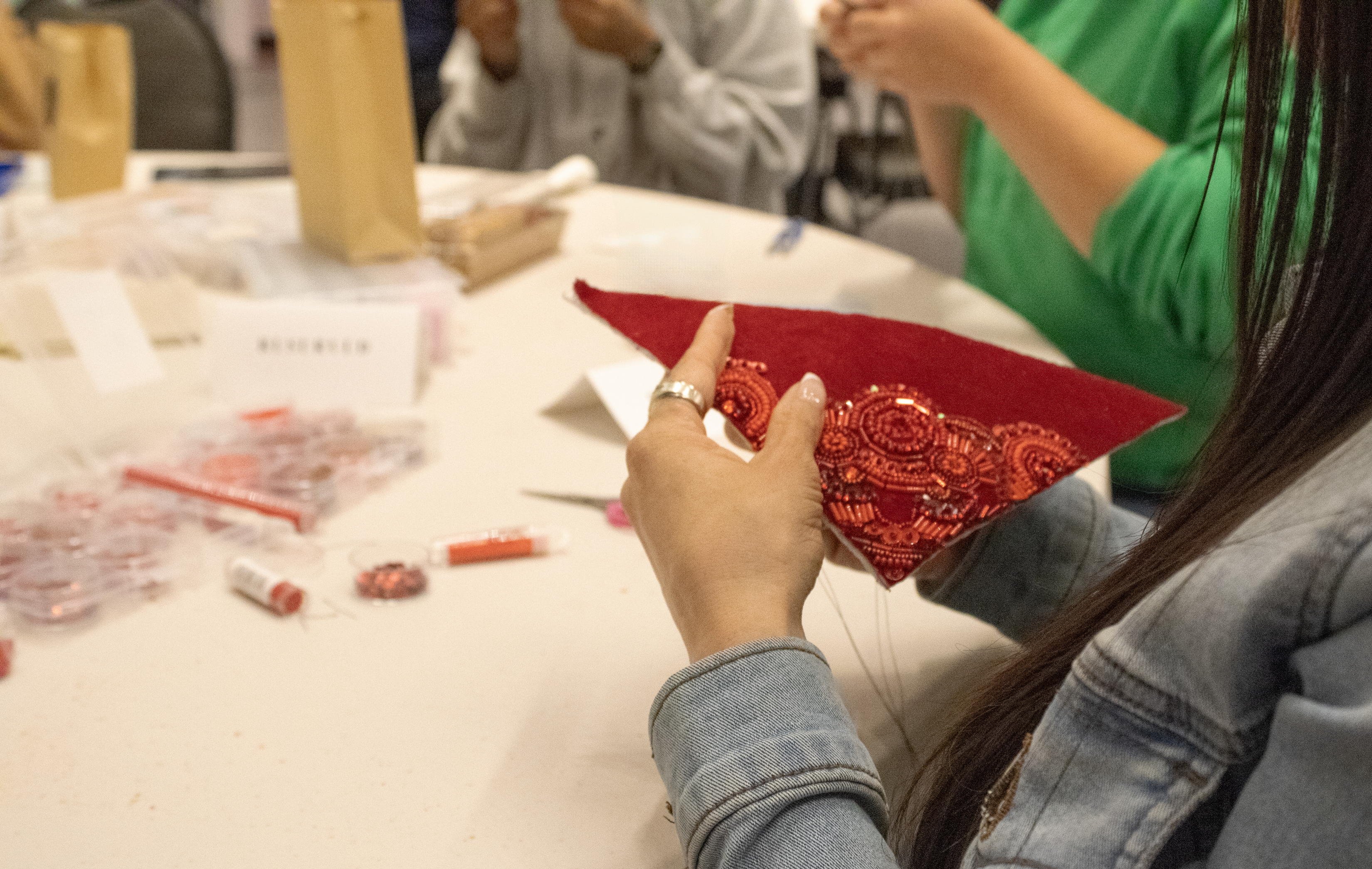
Légende de l'image : L'autrice et ses amies font du perlage. © Calvin Cyr, 2026.
Références
- Adelson, N. (2000). 'Being Alive Well': Health and the Politics of Cree Well-being (Vol. 16). University of Toronto Press.
- Alfred, T. & Corntassel, J. (2005). Being Indigenous: Resurgences against contemporary colonialism. Government and Opposition, 40(4), 597-614.
- Anderson, K. (2011). Life stages and Native women: Memory, teachings, and story medicine (Vol. 15). Univ. of Manitoba Press.
- Ansloos, J., Morford, A. C., Dunn, N. S., DuPré, L., & Kucheran, R. (2022). “Beading Native Twitter: Indigenous arts-based approaches to healing and resurgence.” The Arts in Psychotherapy, 79, 101914.
- Bell, B. (2019). Indigenous Wholistic Health and Wellbeing and Healing. In Dunn, Peter A. Holistic Healing: Theories, Practices, and Social Change. Canadian Scholars.
- Berlo, J. C., & Phillips, R. B. (2015). Native North American Art. (Second edition.). Oxford University Press.
- Bowler, S. (2020). Stitching ourselves back together: urban Indigenous women's experience of reconnecting with identity through beadwork. (Doctoral dissertation, University of Manitoba (Canada)), 2020.
- Brown, A., & Knowles, A. (2022). Holding Space for Future Matriarchs: Digital Platforms for Resurging Solidarity. Gender, Sex, and Tech!: An Intersectional Feminist Guide, 249. Fellows, J. J., & Smith, L. (Eds.).
- Brown, J. (1980). Strangers in Blood: Fur Trade Company Families in Indian Country. UBC Press.
- Brown, J. S. (1983). ‘Woman as centre and symbol in the emergence of Metis communities.’ Canadian Journal of Native Studies, 3(1), 39-46.
- Deyhowähda·dih (Powless, Bradley). (2022). Two Row Wampum – Gä-sweñta. Onondaga Nation, People of the Hills. URL: https://www.onondaganation.org/culture/wampum/two-row-wampum-belt-guswenta/. Accessed 13 May 2026.
- Dubin, Lois Sherr. (2009). ‘North America.’ In The History of Beads: From 100,000 B.C. to the Present, 261-290. New York: Abrams.
- Farrell Racette, S. (2008). ‘My Grandmother Loved to Trade: The Indigenization of European Trade Goods in Historic and Contemporary Canada.’ Journal of Museum Ethnography, (20), 69-81.
- Frantz, F. (1963). Wretched of the Earth. Grove Press.
- Gray, M. J. (2017). Beads: Symbols of Indigenous cultural resilience and value. MA Thesis, University of Toronto (Canada).
- Green, Joyce. 'Sexual Equality and Indian Government: An Analysis of Bill C-31 Amendments to the Indian Act.' Native Studies Review 1, no. 1 (1985): 81-95.
- Greyeyes, C., & Vipond, C. M. (2022). ‘What is home? Wisdom from Nêhiyawêwin.’ Radical Housing Journal, 3(2), 9-24.
- Guédon, M. F. (2020). ‘Introduction.’ Matrix: A Journal for Matricultural Studies, 1(1), 3-7.
- Hill, R. W., & Coleman, D. (2019). ‘The two row wampum-covenant chain tradition as a guide for indigenous-university research partnerships.’ Cultural Studies ↔ Critical Methodologies, 19(5), 339–359.
- Joly de Lotbinière, P. (1991). Western Perspectives and Algonquin Narratives: divergent interpretations of the Wampum tradition. Mémoire de maîtrise, Université de Montréal, Montréal.
- Kappo, T. V. (2021). mîkistahikâcimo (to tell a story through beadwork). MA Thesis, Faculty of Native Studies, University of Alberta.
- Linklater, R. (2014). Decolonizing Trauma Work: Indigenous Stories and Strategies. Winnipeg: Fernwood Publishing.
- Marsden, D. (2004). Expanding knowledge through dreaming, wampum and visual arts. Pimatisiwin: A Journal of Aboriginal and Indigenous Community Health, 2(2), 53-73.
- Miller, J R. Skyscrapers Hide the Heavens: A History of Indian-White relations in Canada. 3rd ed. Toronto: University of Toronto Press, 2000.
- Muller, K. V. (2004). The Two Row Wampum: historic fiction, modern reality. MA Thesis, Université Laval.
- Poitras, P. (2025). Best Work is 6 Feet Under, Ceremony in the Dirt. Doctoral dissertation, OCAD University.
- Racette, S. F. (2009). ‘Looking for stories and unbroken threads: Museum artifacts as women’s history and cultural legacy.’ In Restoring the balance: First Nations women, community, and culture, Winnipeg: University of Manitoba Press. 283-312.
- Ray, L. (2016). ‘“Beading Becomes a Part of Your Life” Transforming the Academy Through the Use of Beading as a Method of Inquiry.’ International Review of Qualitative Research, 9(3), 363-378.
- Royal Commission on Aboriginal Peoples. (1996). Volume 3: Gathering strength. Ottawa: Canada Communication Group. 223–224. URL: https://data2.archives.ca/e/e448/e011188230-03.pdf. Accessed 30 March 2026.
- Robertson, C. (2017). ‘Land and beaded identity: Shaping art histories of Indigenous women of the flatland.’ RACAR: revue d'art canadienne/Canadian Art Review, 42(2), 13-29.
- Settee, Priscilla. (2011). The strength of women: âhkamêyimowak. Regina: Coteau Books.
- St-Denis, N., & Walsh, C. (2016). ‘Reclaiming my Indigenous identity and the emerging warrior: An autoethnography.’ Journal of Indigenous Social Development, 5(1). 1-17.
- Truth, & Reconciliation Commission of Canada. (2015). Final Report of the Truth and Reconciliation Commission of Canada, What we Have Learned: Principles of Truth and Reconciliation. James Lorimer & Company. URL: https://nctr.ca/wp-content/uploads/2021/01/Principles_English_Web.pdf. Accessed 13 May 2026.
- Van Kirk, S. (1980). Many tender ties: Women in fur-trade society, 1670-1870. University of Oklahoma Press.
- Wesley-Esquimaux, C. C. (2009). ‘Trauma to resilience: Notes on decolonization.’ Restoring the balance: First Nations women, community, and culture. Winnipeg: University of Manitoba Press. 13-34.
- Wilson, Angela Cavender. (2005). ‘Reclaiming our humanity: Decolonization and the recovery of Indigenous knowledge.’ War and border crossings: Ethics when cultures clash. Oxford: Rowman & Littlefield Publishers, Inc. 255-263.
- Wood, L. G.G. (2025). Indigenous Cultural Supports Within the Early Years Program. MEd Thesis, Department of Educational Psychology, University of Alberta.